Announcement: Announcement:
designinform:
ReVIEW [digital library]
designinform
has recently embarked on a major two-year project to digitize
most of the leading European and American art journals
published between the 1870s and the early 1920s - making
several of them available for the first time online. It
will be a significant contribution to art history scholarship
and will open up many new areas of research.
• We are aiming for 100% accuracy when proof-reading
the OCR text. This will enable ReVIEW
to be used in conjunction with translation and text-to-voice
services.
• We are developing a new interface for the ReVIEW
database to make it easier to search the vast number of
journals that we are digitising.
• All of the titles will be cross-searchable, together
with the designinform
databases Design Abstracts Retrospective and
Design ProFILES
ReVIEW will eventually include many hundreds
of thousands of pages of text and images. When complete,
it will be an invaluable resource for research into the
history of the Aesthetic movement, Art Nouveau, the Arts
and Crafts movement, the origins of Modernism, the artists
and designers associated with the Wiener Werkstätte,
the early days of the Bauhaus, the flowering of the poster,
the art of World War One, the genesis of Art Deco, the
influence of Japan, the major international exhibitions
such as Paris 1889 and 1900, Glasgow 1901, Turin 1902,
St. Louis 1904, Brussels 1910, and San Francisco 1915,
and the hundreds of thousands of architects, artists and
designers active during these years
DESIGN RESEARCH PUBLICATIONS
Poundsford . Vicarage Lane . Burwash . East Sussex . England
TN19 7JS
T:
+44 1435 883950 . E: [email protected] . W: www.designinform.co.uk
 •
The American Art Review: A Journal Devoted To The Practice,
Theory, History, and Archaeology of Art •
The American Art Review: A Journal Devoted To The Practice,
Theory, History, and Archaeology of Art
Boston,
Massachusetts [etc.]: D. Estes and C. E. Lauriat, monthly,
1879-1881
[The
period covered by designinform
ReVIEW 1879-1881; digitized 1880-81; 1879 available
1912]
The
American Art Review was founded and edited by Sylvester
Rosa Koehler (1837-1900). Born in Leipzig, Germany, he
emigrated with his family to the USA in 1849. He subsequently
became Technical Manager of the lithograph publisher Louis
Prang and Company, and the first curator of prints at
the Museum of Fine Arts in Boston. In his introduction
to volume 1 of The American Art Review (1879), Koehler
proclaimed that his aim in establishing the journal was
to create a periodical that would “occupy a position
analogous to that held by the ‘celebrated’
European publications Gazette des Beaux Arts, L’Art,
the Portfolio, and the Zeitschrift für bildende Kunst.
Although The American Art Review was to survive for only
two years, largely as a result of its lavish production
costs, it is generally acknowledged today as a primary
catalyst in fostering the art of etching in America. Notable
among the artists who were commissioned to produce original
etchings for the journal were Otto Bacher, J.M. Falconer
Thomas and Peter Moran, Henry Farrer, Samuel Coleman,
Anna Lea Merritt, Robert Swain Gifford, Alfred Brennan,
James D. Smillie, John Foxcroft Cole, and Marcel Gaugengigl.
Significant among the articles published by The American
Art Review were ‘A History of Wood-Engraving in
America’ by W.J. Linton; and ‘American Stained
Glass’ by R. Riordan.
 •
L'Art Décoratif: Revue Mensuelle d'Art Contemporain
[subtitle varies] •
L'Art Décoratif: Revue Mensuelle d'Art Contemporain
[subtitle varies]
Paris,
France: Bureaux de L’Art Décoratif, 1898-1914
[The
period covered by designinform
ReVIEW will be 1898-1914. Available 2013]
L’Art
Décoratif was founded by the German writer and
publisher Georg Hirth (1841-1916) as a French companion
to the Munich-based decorative arts journal Dekorative
Kunst. Hirth’s aim was to supply the new movement
in art “with a critical theory, supporting Van de
Velde and the more functional designers” [Anthony
Burton ‘Nineteenth Century Periodicals’ in
‘The Art Press: Two Centuries of Art Magazines’,
edited by Trevor Fawcett and Clive Phillpott. London:
The Art Book Company, 1976 p.9]. The journal initially
focused exclusively on contemporary decorative and applied
art, however, before long it broadened its coverage to
include early art and fine art. This is reflected in the
subtitle it later adopted, Revue de L’Art et de
la Vie Artistique Moderne.
In
August 1902, L’Art Décoratif absorbed Revue
des arts Ddécoratifs and in June 1914 it merged
with Art et Décoration
 •
Art et Décoration: Revue Mensuelle d’Art
Moderne •
Art et Décoration: Revue Mensuelle d’Art
Moderne
Paris,
France: Librairie Centrale des Beaux Arts, 1897-1933.
[The
period covered by designinform
ReVIEW is 1897-1922. Digitized 1893-1911; 1911-1922
available 2012]
Art
et Décoration, could be described as “the
French Studio”. It was launched four years after
its British counterpart and had the same editorial style
as The Studio with long, well-illustrated articles on
contemporary fine, decorative and applied art, together
with book and exhibition reviews and news items.
The
focus of Art et Décoration was on French, Belgian
and Western European art. It includes extensive coverage
of several international exhibitions including the Exposition
Universelle et Industrielle in Paris in 1900.
Publication
of Art et Décoration was suspended between August
1914-April 1919. In June 1914 it absorbed L’Art
Décoratif
 •
The Art Journal •
The Art Journal
London:
Hodgson & Graves; Samuel Carter Hall; George Virtue,
monthly, 1839-1912
[The
period covered initially by designinform
ReVIEW will be 1870-1912]
Art
Journal was the longest running and possibly the most
important art periodical of the Victorian period. It originated
as the Art Union Monthly Journal in 1839 and renamed The
Art Journal in 1849 following its acquisition by the publisher
George Virtue (1794-1868). The editor of the journal for
the first forty-years its history was Samuel Carter Hall
(1800-1889). For much of that time he was also its proprietor.
Hall was succeeded as editor by Marcus Bourne Huish (1843-1921),
who ran the journal until 1892. Huish did much to widen
the range of subject matter covered, allowing etchings
and photographically-reproduced illustrations to displace
steel engraving. Huish, in turn, was replaced by David
Croal Thompson (1855-1930) who was editor from 1893 to
1902. Under Thompson, The Art Journal showed greater interest
in the decorative arts fostered by the Arts and Crafts
movement. By the end of the nineteenth century, The Art
Journal was facing fierce competition from numerous other
art periodicals, notably The Magazine of Art (founded
1878), The Studio (founded 1893), The Connoisseur (founded
1901), and The Burlington Magazine (founded 1903). The
Art Journal eventually ceased publication in 1912.
 •
The Art Student: An Illustrated Magazine conducted by
Members of the Birmingham School of Art •
The Art Student: An Illustrated Magazine conducted by
Members of the Birmingham School of Art
Birmingham,
England: Cornish Bros, New Street; Midland Educational
Co, 1885-1887
[The
period covered by designinform
ReVIEW will be 1885-1887. Available 2013]
The
Art Student contains a wide range of articles on the fine
and decorative arts, including examples of work by students
at the school. The format and standard of production of
the journal is comparable with any of the leading contemporary
art serial publications such as the Magazine of Art, the
Art Journal or The American Art Review
The
Art Student includes articles on stained glass, repoussé
work, art education, the National Competition of 1885
and 1886, chromo-lithography, ‘Hope’ by G.F.
Watts (1817-1904), etc. Among the journal’s contributors
were the artists Thomas Cooper Gotch (1854-1931), Joseph
Finnemore (1860-1939), John Fullwood (1854-1931) and Thomas
Spall (1853-?).
 Artwork Artwork
London,
England: Artwork Publishing Co., 1924-1931
[The
period covered by designinform
ReVIEW is 1924-1931. Available 2013]
Initially
subtitled An Illustrated Quarterly of the Arts and Crafts,
and later The International Quarterly of Arts and Crafts,
Craftwork was published in 7 volumes (28 issues). It was
edited by Herbert Wauthier (1924-28); D.S. McColl (1929-30);
and Randolf Schwabe (1930-1931).
The
journal was a critical review of contemporary fine, decorative
and applied art. It contains articles on wall decoration,
sculpture, poster art, hand printing, photography, scenography,
wood engraving, woodcuts, furniture design, batik, industrial
design, stained glass, etching, medal design, architectural
drawing, advertising art, ceramics, lithography, silversmithing,
glass art, prints, illustration, architecture, documentary
films, textile design, etc.
Contributors
to Artwork included, James Laver, John Grierson, R.H.
Wilenski, John Rothenstein, Douglas Percy Bliss, Martin
Hardie, Sir Reginald Blomfield, Henry Tonks, John Gloag,
E.O. Hoppé, Bernard Rackham, Jacob Epstein, Wyndham
Lewis, Charles Ginner, Gordon Craig, Omar Ramsden, E.
McKnight Kauffer, Edward Wadsworth, Frederick Etchells,
Robert Anning Bell, Eric Gill, Gordon Russell, Paul Nash,
William Rothenstein, Muirhead Bone, etc.
Among artists whose work is discussed or illustrated in
Artwork include C.R.Ashbee, Frank Brangwyn, Ivan Mestrovic,
W.G. Raffé, Eric Gill, William Roberts, E. McKnight
Kauffer, Georg Jensen, Bernard Leach, Eric Ravilious,
Aristide Maillol, René Lalique, Diego Rivera, Frans
Masereel, John Skeaping, Edward Bawden, Charles Rennie
Mackintosh, Walter Crane, David Jones, Katherine Pleydell-Bouverie,
Dora Braden, Edward Johnston, Pablo Picasso, Aubrey Beardsley,
etc.
 •
The Art Workers’ Quarterly •
The Art Workers’ Quarterly
London,
England: Chapman & Hall, 1902-1906
[The
period covered by designinform
ReVIEW is 1902-1906. Digitized]
The
editor of The Art Workers' Quarterly was W.G. Paulson
Townsend, author of several books and articles on the
decorative arts. In his foreword to volume 1, no. 1, he
wrote that the object of the journal, was to provide a
source of inspiration for art workers and “to supply
designs in a readily applicable form to those who do not
invent, plan, or adapt ornament, and who find difficulty
in obtaining good and suitable suggestions for their work.
Further, it is his aim to assist those who may have some
knowledge of the principles on which ornamental design
is constructed, by publishing specimens of good work from
the best historical and contemporary examples”.
Like
The Craftsman, launched the previous year in the USA,
William Morris was the subject of the first article in
The Art Workers’ Quarterly. Subsequent articles
reported on the work and activities of the leading art
schools including the Royal Academy Schools, Royal School
of Art Needlework, the Royal College of Art, Central School
of Arts and Crafts, Camberwell School of Arts and Crafts,
and Keswick School of Industrial Arts, and the principle
craft organizations, guilds and societies such as the
Church Crafts League, the Home Arts and Industries Association,
the Dress Designers Exhibition Society, the Clarion Guild
of Handicrafts, and the Arts and Crafts Exhibition Society.
There are also articles on the British Section at the
St. Louis Exposition of 1904; the Impact of Modern Social
and Economic Conditions on the Decorative Arts; the architecture
of Letchworth Garden City, etc. These were interspersed
with practical, well-illustrated articles on wood block
printing, mural decoration, ornamental lettering, metalwork,
embroidery, weaving, furniture, ceramics, stained glass,
bookbinding, etc.
Townsend
was successful in attracting many of the leading commentators
on the decorative arts to write pieces for The Art Workers’
Quarterly, including May Morris, Walter Crane, J. Illingworth
Kay, Alexander Fisher, Lawrence Weaver, Bernard Rackham,
Silvester Sparrow, Alfred Stevens, A. Romney Green, and
James Guthrie.
Among artists and designers whose work featured in The
Art Workers’ Quarterly were some of the major figures
in the English Arts and Crafts movement including Ambrose
Heal Jr., Walter Crane, C.F.A. Voysey, Alexander Fisher,
May Morris, R.A. Dawson. W.J. Neatby, Harold Stabler,
Allan Vigers, W. Curtis Green, A. Romney Green. Heywood
Sumner, Charles E. Dawson, Edward Spencer, Bernard Cuzner,
Arthur Gaskin, Charles Spooner, C.R. Ashbee, Paul Woodroffe,
Ernest Gimson, Mary Seton Fraser Tytler (Mrs G.F. Watts),
Ernestine Mills and Sidney Barnsley.
An additional two special issues of The Art Workers’
Quarterly were published in August and December 1908.
These contained the papers and extracts of papers read
at the Third International Art Congress for the development
of Drawing and Art Teaching and the Application to Industries
held in London in August 1908, as well as a record of
the Retrospective Exhibition of Students’ Works,
held at the Victoria & Albert Museum, London, in connection
with the Congress. Together with volumes 1-5 of The Art
Workers’ Quarterly, these have also been digitized.
for designinform ReVIEW
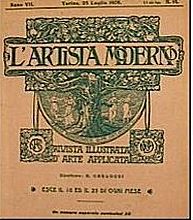 •
L’Artista Moderno: Rivista illustrata d’arte
applicata [subtitle varies] •
L’Artista Moderno: Rivista illustrata d’arte
applicata [subtitle varies]
Turin,
Italy: Società Tipografico-Editrice Nazionale (S.T.E.N.),
1901-1941
[The
period covered by designinform
ReVIEW will be 1904-1922. Available 2013]
Despite
its long history, L'Artista Moderno is extremely scarce
and little known outside Italy. It is one of the most
important sources on contemporary decorative art, particularly
the Stile Liberty (Art Nouveau) style, in Italy during
the period covered by designinform ReVIEW. It was published
bi-monthly and contains well-illustrated articles on ceramics,
glass, furniture, poster design, graphic art, jewellery
metalwork, textiles, interior design and architecture.
In
its latter years L'Artista Moderno was superseded by more
radical Italian arts journals such as Domus.
 •
Artistic Japan: A Monthly Illustrated Journal of Arts
and Industries •
Artistic Japan: A Monthly Illustrated Journal of Arts
and Industries
London,
England: Sampson Low, Marston, Searle & Rivington,
1888-1891
[The
period covered by designinform
ReVIEW is 1881-1891. Available 2012]
Founded
and compiled by the German art dealer S. (Siegfied) Bing
(1838-1905) Artistic Japan was published simultaneously
in English, German [Japanischer Formenschatz] and French
[Le Japon Artistique]. Bing’s declared aim in producing
the journal was to “stimuler l’intérêt
des amateurs” and “exercer une influence sur
le goût, la culture, l’art et la constitution
des collections publiques et privées” (stimulate
the interest of amateurs and to influence the taste, culture,
art and formation of public and private collections) in
the art of Japan. One of the publication’s chief
sponsors was the fashionable London retail firm Liberty
& Co. who had a full-page colour advertisement for
their art fabrics on the back page of every issue of the
English edition.
The
journal contains a series of illustrated essays on architecture,
engraving, Hokusai’s “Man-gwa”, the
decoration of swords, Ritsuo and his School, netsukés
and okimonos, the theatre in Japan, Hiroshigé,
the poetic tradition in Japanese art, Animals in Japanese
art, and Korin.
Among
contributors to Artistic Japan were Edmond de Goncourt,
Roger Marx, Victor Champier, and Eugène Guillaume.
The editor of the English edition was Marcus B. Huish
(1843-1921).

•
Les Arts: Revue Mensuelle des Musées, Collections,
Expositions
Paris:
Goupil & Cie, monthly, 1902-1920
[The
period covered by designinform
ReVIEW will be 1902-1920. Available 2013]
The
editors and co-proprietors of Les Arts were Michel Manzi
(1902-1914) and Maurice Joyant (1916-1920). The journal
covered the fine and decorative arts, both early and modern,
and contained long well-illustrated articles, including
an annual report on the Paris Salons. Les Arts was, however,
rather conservative and contained little on the avant-garde
movements active in Paris during years of its publication.
This possibly reflected the taste of its editors, who
were art dealers, collectors and co-owners of Galerie
Manzi-Joyant, a fine art gallery and publishing house
in Paris.
Manzi
was an acquaintance of Edgar Degar who painted him in
c.1889, and Joyant was a close friend of Toulouse-Lautrec
and organised retrospectives of his work in 1902, 1907
and 1914.
 •
Arts & Crafts. A Monthly Magazine for the Studio, the
Workshop & the Home •
Arts & Crafts. A Monthly Magazine for the Studio, the
Workshop & the Home
London,
England: Hutchinson & Co., 1904-1906
[The
period covered by designinform
ReVIEW is 1904-1906. Available 2012]
Intended
for both the professional and the amateur craftsperson,
Arts & Crafts is an important source on the middle
period of the Arts and Crafts movement in England. In
addition to practical articles on craftmaking, particularly
jewellery, bookbinding, furniture, metalwork and embroidery,
it included articles on the work of some of the leading
names in the Arts and Crafts movement, such as M.H. Baillie
Scott, and Walter Crane. It also contained book reviews
and reports on exhibitions of the Arts and Crafts Exhibition
Society, the Paris Salon, the Royal Academy, etc.
•
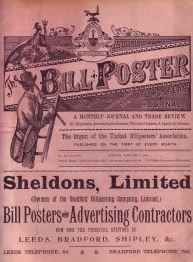
The Bill Poster
London:
United Billposters’ Association, monthly, 1887-1910
[The
years covered initially by designinform
ReVIEW will be 1892. 1896. Available
2013]
The
Bill Poster was the official journal of the United Billposters’
Association. The subtitle varies.
The
journal provides an interesting insight into poster
and outdoor advertising from the perspective of the
printer and the distributor. In addition to trade news,
these issues contain an eclectic range of articles including
Pigs as Advertising Mediums; An Australian View of Highly
Coloured Posters; Indecent Posters; Objectionable Hoardings;
Billposting in India; the Nude in Art; Street Lamp Advertising;
the ‘Cute’ Billposter; the Pictorial Poster;
Jules Cheret’s Posters; The Horrors of Newspaper
Advertisements; Celestial Advertising [projecting advertising
messages on to clouds]; Railway Station Name Boards;
Omnibus Advertisements; American Billposters’
Associations; the 1896 Poster Show in Philadelphia;
The Poster Artist at Home [an interview with Théophile-Alexandre
Steinlen]; ‘Poster Parties’; and Electric
Signs.
Like
many trade journals of this period, The Bill Poster
is extremely scarce. We are hoping to digitize more
issues at a later date.
 •
Brush and Pencil: An Illustrated Magazine of the Arts
of Today [subtitle varies slightly] •
Brush and Pencil: An Illustrated Magazine of the Arts
of Today [subtitle varies slightly]
Chicago,
Illinois: The Arts and Crafts Publishing Company / The
Brush and Pencil Publishing Company, monthly, 1897-1907
[The
period covered by designinform
ReVIEW will be 1897-1907. Available 2013]
Brush
and Pencil was the official journal of the Brush and Pencil
Club in Chicago. It was a well-illustrated review of contemporary
American painting and sculpture, with occasional articles
on the decorative and applied arts and work by foreign
artists. It also contained a monthly round-up of art news,
together with book reviews and exhibition reports.
The
first editor of Brush and Pencil was Charles Francis Browne
(1859-1920), an instructor at the Art Institute of Chicago
and one of the founders of the Club.He was succeeded by
Frederick William Morton (1859-1935) who remained its
editor until the closure of the magazine in June 1907.
 •
Cabinet Maker and Art Furnisher: A Monthly Budget of Designs
and Information for the Furniture, Upholstery and Decorating
Trades •
Cabinet Maker and Art Furnisher: A Monthly Budget of Designs
and Information for the Furniture, Upholstery and Decorating
Trades
London,
England: Benn Brothers, 1880-1902
[The
period covered initially by designinform
ReVIEW will be 1880-1896. Available 2013]
Cabinet
Maker and Art Furnisher was published monthly and edited
by J. William Benn. It was the leading journal for the
furniture and furnishing trade in Britain in the late
Victorian period and is one of one of the principal sources
for research on design and manufacture in this sector
during these years.
The
focus of the journal is very much on design. It is extensively
illustrated and contains numerous articles. It also includes
reports on current trends, a round up of trade news, reviews
of trade literature, details of new patents, etc.
By
1890 Cabinet Maker and Art Furnisher incorporated a number
of other trade publications including The Upholstery &
Decorating Journal; Carpet & Floor-Covering Record;
Furnishing Hardware Guide, and Timber-Yard & Woodworking
Machinist.
 •
Colour Magazine •
Colour Magazine
London,
England: Colour Magazine, monthly, 1914-1932
[The
period covered initially by designinform
ReVIEW will be 1914-1922. Available 2012]
Colour
contained an eclectic mixture of short stories, poetry,
and articles about art. What makes it particularly interesting
is its numerous reproductions (mainly in colour) of work
by contemporary British painters, notably by members of
the Camden Town Group and the London Group, such as Robert
Bevan, Walter Sickert, Harold Gilman and Charles Ginner.
It also includes many examples of work by First World
War artists.
The
digitization will include all the advertisements that
accompany the magazine.
 Commercial
Art Commercial
Art
London, England: Commercial Art Ltd.,
monthly, 1922-1926
[The
period covered by designinform
ReVIEW will be 1922-1926. Available 2012]
Commercial
Art was published by Commercial Art Ltd. in 5 volumes
(42 issues) between October 1922 and June 1926. It was
conceived as a trade journal for the British advertising
industry and contains numerous, well-illustrated articles
on posters, poster stamps, printing, typography, letter
art, illustrations, signage, point-of-sale and window
display, packaging, etc.
Among artists whose work is discussed or illustrated in
Commercial Art include E. McKnight Kauffer, Fred Taylor,
Tom Purvis, Reginald Frampton, Jean d’Yllon, Austin
Cooper. G.M. Ellwood, H.M. Bateman, Frank Brangwyn, Harold
Nelson, Fred Pegram, E.A. Cox, Frank Newbould, Herrick,
Aldo Cosmati, Charles Pears, Horace Taylor, Lovat Fraser,
Anna and Doris Zinkeisen, Laurie Taylor, Septimus Scott,
Rilette, F. Gregory Brown, Edmund J. Sullivan, George
Sheringham, Robert Braun, Frederic W. Goudy, Paul E. Derrick,
etc.
 •
The Craftsman •
The Craftsman
Eastwood,
N.Y.: United Crafts, 1901-1916.
The
period covered by designinform
ReVIEW 1901-1916. Digitized]
The
Craftsman played a seminal role in promoting the philosophy
and ideals of the Arts and Crafts movement in America.
It was founded by the designer Gustav Stickley (1858-1942)
and published by his United Crafts workshop in Eastwood,
New York.
The
influence of the English craft aesthetic on the The Craftsman
is evident in the fact that four of the five articles
in the first issue of the journal were on the work of
William Morris and Morris & Company, and the second
issue was largely devoted to the writings of John Ruskin.
Other articles in the first two years of the journal included
‘Revival of English Handicrafts: the Haslemere Industries’;
‘Cobden-Sanderson and the Doves Bindery’;
and ‘Some Cornish Craftsmen’. It was only
towards the end of the second year of The Craftsman that
it began to turn its attention to the crafts in other
countries, and particularly America. Later articles in
the journal include ‘René Lalique: His Rank
Among Contemporary Artists’; ‘L’Art
Nouveau, Its Origin and Development’; ‘Rookwood
Pottery’; ‘Workshops and Residence of M. René
Lalique’; ‘L'Art Nouveau: An Argument and
Defence’; ‘Korin and the Decorative Art of
Japan’; ‘Japanese Book Illustrations’;
‘Craftsmanship in the New York Schools’; ‘The
Influence of the "Mission Style" Upon the Civic
and Domestic Architecture of Modern California’,
‘August Rodin’; ‘Mural Painting from
the American Point of View’; 'Tiffany and Company,
at the St. Louis Exposition’; ‘The Future
of Ceramics in America’; ‘Rossetti and Botticelli:
a Comparison of Ideals and Art’; ‘The Decorations
of the Chancel of Saint Thomas' Church, New York City:
Work of John La Farge and Augustus St. Gaudens’;
‘The New Art in Photography: Work of Clarence H.
White, a Leader Among the Photo-Secessionists’;
‘Photography as One of the Fine Arts: the Camera
Pictures of Alvin Langdon Coburn’; ‘Is There
a Sex Distinction in Art? The Attitude of the Critic Toward
Women's Exhibits’; ‘Why the Handicraft Guild
at Chipping Campden Has Not Been a Business Success’;
‘Modern German Art: its Revelation of Present Social
and Political Conditions in Prussianized Germany’;
‘An afternoon with Walter Crane’; ‘Town
Planning in Theory and in Practice: the Work of Raymond
Unwin’; ‘Mary Cassatt's Achievement: its Value
to the World of Art’; ‘The strange genius
of Aubrey Beardsley’; and ‘The new idea in
French furniture, as expressed by Maurice Dufrène’.
Gustav
Stickley wrote frequently for The Craftsman. Among other
contributors were Charles F. Binns, Ernest A. Batchelder,
Ralph Waldo Emerson, G.K. Chesterton and Leopold Stokowski.
 •
Dekorative Kunst: Zeitschrift für angewandte Kunst
[subtitle varies] •
Dekorative Kunst: Zeitschrift für angewandte Kunst
[subtitle varies]
Munich,
Germany: Verlaganstalt F. Bruckmann A.-G., 1897-1929
[The
period covered by designinform
ReVIEW is 1897-1922. Digitized]
Dekorative Kunst was founded by H. (Hugo) Bruckmann (1863-1941),
in association with the art critic J. (Julius) Meier-Graefe
(1867-1935) and the writer and publisher Georg Hirth (1841-1916).
The journal focused exclusively on contemporary decorative
and applied art, particularly furniture, interior design,
ceramics, glass, jewelry, metalwork and textiles. It played
a significant role in promoting the Art Nouveau and Arts
and Crafts movements in Germany. In its early years, coverage
was international, however, after c.1910 the journal concentrated
more on the German and Austrian art.
Notable
among contributors to Dekorative Kunst were the art dealer
S. (Siegfied) Bing (1838-1905), and the writer/designers
Henry van de Velde (1863-1957) and Hermann Muthesius (1861-1927).
Among the numerous artists and designers whose work feature
in the journal are Peter Behrens, Richard Riemerschmid,
C.R. Ashbee, M.H. Baillie Scott, C.F.A. Voysey, C.R. Mackintosh,
Josef Hoffmann, Koloman Moser and Gustav Klimt.
 •
Details: A Monthly for Those Interested in Architecture
and the Allied Arts •
Details: A Monthly for Those Interested in Architecture
and the Allied Arts
London,
England: Details Magazine, 1909 [all 12 issues published]
[The
period covered by designinform
ReVIEW is 1909. Available 2013]
Edited
by the architect, R. Randal Phillips (1878-1967), this
short-lived monthly journal contains detailed descriptions,
photographs and plans of architectural features in contemporary
British buildings. Includes arcades, balconies, bridges,
carvings and sculpture in stone and wood, chimney-pieces
and fireplaces, church work, doors, doorways and entrances,
door furniture, floors, gates, gate piers and railings,
leadwork, panelling, plasterwork, ponds and fountains,
shop fronts, staircases, wall treatments, and windows
and window treatments. Among architects whose work is
included are J.D. Sedding, Edwin Lutyens, Aston Webb,
E. Guy Dawber, Ernest Newton, Maxwell Ayrton and W.H.
Bidlake.
Details
was absorbed into the Architectural Review in January
1910.
 •
Deutsche Kunst und Dekoration •
Deutsche Kunst und Dekoration
Darmstadt,
Germany: Alexander Koch, 1897-1932.
[The
period covered by designinform
ReVIEW is 1897-1922. Digitized 1893-1911; 1911-1922
available 2012]
Deutsche
Kunst und Dekoration was founded, edited and published
by Alexander (Alex) Koch (1860-1939). It is sometime known
as “the German Studio”, and was launched four
years after its British counterpart. It is similar, both
in size and format, to The Studio, and like its predecessor,
primarily covers contemporary decorative and fine art.
In addition to well-illustrated articles it also includes
book and exhibition reviews and news items.
Although
international in its scope, Deutsche Kunst und Dekoration
predominantly covered German, Austrian, Scandinavian and
Central European art. It contained extensive reports on
the Exposition Universelle et Industrielle in Paris in
1900, the Esposizione Internazionale d’Arte Decorativa
Moderna held in Turin in 1902, and the work of the Wiener
Werkstätte and by members of the Deutscher Werkbund.
 •
L’Exposition de Paris 1889 •
L’Exposition de Paris 1889
Paris,
France: En Vente à la Librairie Illustrée,
1888-1889
[The
period covered by designinform
ReVIEW is 1888-1889. Digitized]
L’Exposition de Paris de 1889 was published in 40
issues between 15 October 1888 and 2 October 1889. It
documents in detail the preparations for and course of
the Exposition Universelle held in Paris between May and
October 1889.
The
journal is an invaluable record of one of the most important
cultural events in France during the nineteenth century.
It is illustrated extensively with photo engravings and
contains numerous reports on every aspect of the Exposition,
notably the construction of the Eiffel Tower, the abiding
symbol of the Fair.
 •
The House: An Artistic Monthly for Those who Manage and
Beautify the Home [subtitle varies] •
The House: An Artistic Monthly for Those who Manage and
Beautify the Home [subtitle varies]
London,
England: Horace Cox, H. Virtue, etc. 1897-1903
[The
period covered initially by designinform
ReVIEW will be 1897-1902. Available 2012]
In
the introduction to the first issue of The House, the
editor observed that “There are now dozens of journals
which have to do with the dressing and adornment of the
body; but strange to say, there is not one dealing exclusively
with the dressing of the house.” This, they asserted
would be the function of The House. Over the next five
years the magazine covered every conceivable aspect of
the furnishing and management of the Victorian home with
articles on furniture, lighting, wallpaper, carpets and
rugs, tiles, art needlework, ceramics, glassware, decorative
woodcarving, stained glass, art metalwork, etc. Among
artists, designers and firms whose work feature in The
House are Walter Crane, Liberty & Co., Heal &
Sons, and John Ruskin. The influence of the Arts and Crafts
movement is evident.
 •
L’Image: Revue Mensuelle Artistic et Litteraire
[Subtitle varies] •
L’Image: Revue Mensuelle Artistic et Litteraire
[Subtitle varies]
Paris,
France: A. Floury, Éditeur, 1896-1897.
[The period covered by designinform
ReVIEW is 1896-97. Digitized]
L’Image
was published monthly between December 1896 and December
1897 by Henri Floury, on behalf of the Corporation Française
des Graveurs sur Bois. The editor was the engraver Tony
Beltrand (1947-1904), who also provided art direction
in collaboration with Léon Ruffe and Auguste Lepère.
The aim of L’Image was to promote and encourage
the art of wood engraving. It featured original work by
many of the leading engravers, illustrators, graphic artists
and painters then active in France including Jules Chéret,
Eugène Carrière, Fantin-Latour, Victor Prouvé,
Henri Bellery-Desfontaines, Puvis de Chavannes, Jean Émile
Laboureur, Alphonse Mucha, Maurice Denis, Eugène
Froment, Léon Perrichon, Georges de Feure, Auguste
Rodin, Kees van Dongen, Edgar Degas, Frédéric
Florian, Georges Jeanniot, Clément Bellenger, Eugène
Carrière, Lucien Pissarro, Henri Rivière,
Jean Veber, and Jacques Beltrand.
Among
artists who were commissioned to design covers for L’Image
were Alphonse Mucha, Toulouse-Lautrec, Henri Bellery-Desfontaines,
Victor Prouvé, Paul Berthon, Georges de Feure,
and Marcel Lenoir.
 •
The Imprint •
The Imprint
London,
England: The Imprint Publishing Co., 1913
[The
period covered by designinform
ReVIEW is 1913. Digitized]
The
Imprint was a short-lived but seminal journal devoted
to the arts of printing, typography, illustration and
lettering. It was published in between January and November
1913. The editors were the influential English typographic
designers F. Ernest Jackson, Edward Johnston, J. H. Mason,
and Gerard T. Meynell, who were assisted by an Advisory
Committee of over 30 artists and individuals from the
realms of art, printing and publishing that included Joseph
Pennell, W.R. Lethaby, Douglas Cockerell, Arthur Waugh,
F. Morley Fletcher, R.A. Austen-Leigh, and Sidney Colvin.
The Imprint contains articles on Poster Advertising on
the London Underground; Children’s Book Illustration
by Walter Crane; Decorative Lettering by Edward Johnston;
Art and Workmanship by W.R. Lethaby; Current Trends in
Illustration by Joseph Pennell; the Wood Engravings of
Lucien Pissarro by J.B. Manson; Liturgical Books by Stanley
Morison; the 1913 Arts and Crafts Exhibition by B. Newdigate;
Post-Impressionism, with some personal recollections of
Vincent Van Gogh and Paul Gauguin, by A.S. Hartrick; Honoré
Daumier by Frank Rinder; the International Colour Printing
and Poster Exhibition of 1913; etc.
 •
Innen-Dekoration •
Innen-Dekoration
Darmstadt,
Germany: Verlaganstalt A. Koch, 1890-1944
[The
period covered initially by designinform
ReVIEW will be 1903-1922. Available 2013]
Innen-Dekoration
originated as Illustrirte kunstgewerbliche Zeitschrift
für Innen-Dekoration in 1890. The title changed in
1900. It was founded, edited and published by Alexander
(Alex) Koch (1860-1939).
The
journal was published monthly and contains well-illustrated
articles on contemporary German and Austrian interiors
and decorative art. It also includes reports on design
trends in other countries.
Among
architects and designers whose work is discussed or illustrated
in Innen-Dekoration are Peter Behrens, Richard Riemerschmid,
Bruno Paul, Josef Hoffmann, H.M. Baillie Scott, Emanuel
Margold, Runge & Scotland, Koloman Moser, Julius Klinger,
Ludwig Hoffmann, Georg Metzendorf, Emanuel von Seidl,
Paul Würzler, Georg Honold, Alfred Altherr, C.R.
Ashbee, Ludwig Hohlwein, Rudolf and Fia Wille, Otto Prutscher,
Henry van de Velde, Hans Ofner, Albin Müller, Karl
Bertsch, Willy von Beckerath, Max Littmann, etc.
 •
The International Studio •
The International Studio
New
York, NY / London, England: John Lane Company [etc.],
1897-1931.
[The
period covered by designinform
ReVIEW will be 1897-1922. Available 2013]
Between
1897-1921, The International Studio was the U.S. edition
of the British fine and decorative arts journal The Studio,
and was produced jointly in New York and London. Although
the focus of The International Studio was art from an
American perspective, for many years it replicated a percentage
of material from the British edition. In 1922 The International
Studio was acquired by International Studio Inc. and henceforth
published exclusively in New York. In September 1931 it
was absorbed into The Connoisseur.
Editors
of The International Studio were Charles Holmes (1868-1936),
from 1897 to 1920; G.C. Eglington, from 1920 to 1922;
Peyton Boswell (1879-1936), from 1922 to 1925; W.B. McCormick,
from 1925 to 1928; and H.J. Whigham (1869-1954), from
1928 to 1931
 •
The Journal of Decorative Art: An Illustrated Technical
Journal for the House Painter, Decorator, and all Art Workmen
[subtitle varies] •
The Journal of Decorative Art: An Illustrated Technical
Journal for the House Painter, Decorator, and all Art Workmen
[subtitle varies]
London,
England: Simpkins, Marshall, Hamilton, Kent & Co.;
Manchester, England: The Decorative Arts Journal Co.,
Ltd. [etc.], 1881-1949
[The
years covered initially by designinform
ReVIEW will be 1896, 1903, 1907. Available 2013]
The
Journal of Decorative Art was the official organ of the
National Association of Master House Painters of England
and Wales. It was published monthly and contains detailed
national and regional reports on current technical and
design trends in the decorative arts, particularly furniture
and surface decoration, together with trade news and reports.
Possibly
because it was a trade journal with a limited circulation,
The Journal of Decorative Art is extremely scarce. It
is an invaluable source for research on late Victorian
and early twentieth century British decorative art from
an industry perspective.
 •
Kunstgewerbeblatt •
Kunstgewerbeblatt
Leipzig,
Germany: Verlag von G. A. Seemann, 1885-1917.
[The
period covered by designinform
ReVIEW will be 1890-1917. Available 2012]
Kunstgewerbeblatt
was a decorative arts journal published in two series
- vols.1-5, 1885-1889; and vols. 1-28, 1890-1917. The
focus of the first series, which was printed in the Gothic
script, was primarily early and traditional German art.
From the second series, the journal was printed in modern
German script and the focus shifted to contemporary art,
particularly Art Nouveau, and the German interpretation
of the Arts and Crafts style. The journal includes well-illustrated
articles on ceramics, glass, jewellery, furniture, metalwork,
and surface decoration and, to a lesser extent, architecture.
The
editors of Kunstgewerbeblatt were: Arthur Pabst (October
1885-September 1894); Karl Hoffacker (October 1894-September
1905); and Fritz Hellwag (June 1908-September 1917)
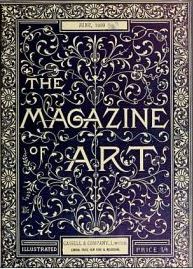
• The Magazine of Art
London
and New York: Cassell & Co [etc.], monthly, 1878-1904
[The
period covered by designinform
ReVIEW will be 1878-1904. Available 2013]
The
Magazine of Art was both similar in its coverage and
format as The Art Journal. Its editors were, in turn,
Arthur James Richens Trendell (1836-1909) from 1878
to 1880; Eric Robertson in 1880-81; William Ernest Henley
(1849-1903) from 1881 to 1886; Sidney Galpin in 1886;
and Marion Harry Spielmann (1858-1948) from 1886 to
1904.
Liela
Rumbaugh Greiman, in her article ‘William Ernest
Henley & The Magazine of Art’ [Victorian Periodicals
Review Vol. 16, No. 2, Summer, 1983, pp. 53-64] observed
that The Magazine of Art had a substantial influence
upon popular aesthetic taste and that it included among
its contributors some of the best essayists and critics
of the late Victorian period. Under Henley’s editorship,
the magazine was transformed from being an “insular,
uninspired trade journal, into a lively, cosmopolitan
review of the arts containing criticism, prose, and
poetry of lasting worth”. During the seventeen
years of Spielmann’s editorship, many of the leading
artists and critics of the day, notably John Ruskin,
were commissioned to write articles for the magazine.
By 1904 The Magazine of Art, like The Art Journal, found
it increasingly difficult to compete with some of the
more dynamic new rivals such as The Studio, and consequently
ceased publication.
 •
Our Homes and Gardens: A Practical Magazine Dealing with
Houses, Furniture & Equipment, Gardens •
Our Homes and Gardens: A Practical Magazine Dealing with
Houses, Furniture & Equipment, Gardens
London,
England: “Country Life” Limited, 1919-1923
[The
period covered by designinform
ReVIEW will be 1919-1922. Available 2013]
In
their forward to the first issue of Our Homes and Gardens,
the publishers wrote: “There is a widespread demand
for a better manner of house design; rooms planned in
keeping with present-day needs; furniture that is graceful
while at the same time being suitable for everyday use;
window hangings and floor coverings that are both serviceable
and pleasing to the eye; and last but not least, features
belonging to the equipment of the house – such as
cooking ranges, sinks, heating apparatus, labour-saving
appliances – that will ensure the utmost convenience
and economy. All these things shall find representation
in our pages”. The magazine is extensively illustrated
and is an interesting record of the furnishing of the
middle-class British home in the immediate post-World
War One years.
•
Das Plakat
Berlin,
Germany: Verlag Max Chiliburger, 1910-1921
[The
period initially covered by designinform
ReVIEW is 1912-1921. Digitized]
Das
Plakat originated as Mitteilungen des Vereins der Plakatfreunde.
It changed to its more familiar title with the January
1913 issue.
Das
Plakat is generally considered to have been the most influential
journal ever produced on the art of the poster. It was
the official publication of the Verein der Plakat Freunde
(The Society for Friends of the Poster) an association
of poster dealers, collectors and designers established
in Berlin in 1905. The founder and driving force behind
the journal was Hans Josef Sachs (1881-1974), a Berlin
dentist with a passionate interest in the poster.
Das
Plakat is extensively illustrated with numerous colour
plates. It covers all aspects of the art of the poster
and in addition to German posters, it includes articles
on poster design and designers in Austria, Hungary, Sweden,
the UK, the USA, the Netherlands, and other countries.
Nearly
every major poster designer active during the years of
its publication are represented in Das Plakat. Adding
to the usefulness of the digitization. we have included
details of all the c.4000 artists, whose work is reproduced,
giving their full name, dates, nationality, etc. We also
intend to subject index [in English] all the articles
and classify all the posters by subject and type.
In
addition to digitizing all but two of the numbers of Das
Plakat from the years 1912-1921, we have digitized several
of the special supplements issued by the journal, including
two supplements on plagiarism in poster design, and a
supplement on the design of wine labels.
For
the significance of this exceptionally rare and important
journal see the 2004 essay by Steven Heller, ‘Graphic
Design Magazines: Das Plakat’ www.typotheque.com/articles/graphic_design_magazines_das_plakat
 •
The Poster: An Illustrated Monthly Chronicle •
The Poster: An Illustrated Monthly Chronicle
Leyton,
Essex, England: E. R. Alexander & Sons; London, England:
Hugh Macleay, 1898-1901.
[The
period covered by designinform
ReVIEW is 1898-1901. Digitized]
The
Poster was the most important journal in English devoted
to the art of the poster. In addition to containing over
3,000 images (several in colour), it included interviews
with and profiles of many of the leading names in poster
design including Toulouse-Lautrec, Steinlen, Alphonse
Mucha, Ethel Reed, Maxfield Parrish, Paul Berthon, Will
Bradley, Arpad Basch, Jules Chéret, Jack B. Yeats,
Aubrey Beardsley, the Beggarstaff Brothers, etc.
The
Poster also includes articles on poster art in Russia,
Italy, France, Germany, Spain, Japan, Belgium, Austria,
Hungary, Denmark, the Netherlands, Great Britain, the
USA, etc., as well as articles on specific aspects of
the poster, including bicycle posters, political posters,
railroad posters, theatre posters, the poster as a mirror
of life, plagiarism in poster design, symbolism in advertising,
etc.
In
its final year (volume 6, 1901) the title was expanded
to The Poster and Art Collector, and it began to include
articles on related aspects of art including the design
of magazine covers, book covers, bookbinding (e.g. a long
article on the Guild of Women Binders), pictorial postcards,
playbills, and theatrical caricatures.
A complete file of The Poster is exceptionally rare, and
because this journal has never been indexed, these articles
are little known. In order to enhance the value of the
digitization, we have classified the posters by subject
and type. We have also added details of all the artists
whose work is reproduced, giving their full name, dates,
nationality, etc. In addition we have added over 1,200
links to web sites containing biographical information
on the artists and examples of their work.
 •
The Studio: An Illustrated Magazine of Fine and Applied
Art [Subtitle varies] •
The Studio: An Illustrated Magazine of Fine and Applied
Art [Subtitle varies]
London,
England: The Studio Ltd., 1893-1964
[The
period covered by designinform
ReVIEW will be 1893-1922. Digitized 1893-1910;
1911-1922 available 2012]
The Studio was one of the most respected and influential
art journals published in Britain. It was international
in its coverage, and contained, long, often well-illustrated,
articles on all aspects of the decorative, fine and applied
arts. It included contributions from many of the leading
art critics of the day, e.g. Aymer Vallance, Walter Crane,
Fernand Knopff and A. Lys Baldry.
Each
issue of The Studio also contained a round-up of the latest
art news, reports on recent exhibitions, and book reviews.
The Studio played an important role in promoting trends
and developments in contemporary art and was largely responsible
for establishing the reputations of many artists notably
Aubrey Beardsley, James McNeill Whistler, and the artists
of the Glasgow School. It was also significant in promoting
the Arts and Crafts movement in Britain.
 •
The Studio Yearbook of Decorative Art •
The Studio Yearbook of Decorative Art
London,
England and New York, NY: The Studio [etc.], 1906-1925
[renamed Decorative Art in 1926]
[The
period covered by designinform
ReVIEW is 1906-1922. Digitized 1906-1913; 1914-1922
available 2012]
The
Studio Yearbook of Decorative Art was an annual review
of some of the finest examples of contemporary architecture
and applied art. Among the architects, designers and companies
whose work feature in these issues are C.R. Ashbee, M.H.
Baillie Scott, Liberty & Co., the Guild of Handicraft,
Heal & Son, Ambrose Heal, Ernest Gimson, Edwin Lutyens,
C.F.A. Voysey, Jessie M. King, William Morris & Co.,
Arthur Sanderson & Sons, Ann Macbeth, Walter Crane,
Frank Brangwyn, Charles Rennie Mackintosh, George Walton,
Heywood Sumner, Peter Behrens, Josef Urban, Josef Hoffmann,
the Wiener Werkstätten, Richard Riemerschmid, Louis
Majorelle, Maurice Dufrène, Henry Holiday, Koloman
Moser, René Lalique, Ernestine Mills, Hermann Muthesius,
Ludwig Mies van der Rohe, Rookwood Pottery, Gio Ponti,
Carl Malmsten, Gunnar Asplund, Edward Hald, Wilhelm Kåge,
Simon Gate, Orrefors Glasbruk, Georg Jensen, etc.
 •
The Yellow Book •
The Yellow Book
London,
England: E. Mathews & J. Lane; Boston, Massachusetts:
Copeland & Day, 1894-1897.
[The
period covered by designinform
ReVIEW is 1894-1897. Available 2012]
In
their prospectus to Volume 1 (April 1894), the publishers
and editors of The Yellow Book wrote that it was their
aim to “depart as far as may be possible from the
bad old traditions of periodical literature, and to provide
an Illustrated Magazine which will be as beautiful as
a piece of book-making, modern and distinguished in its
letter-press and its pictures, and withal popular in the
better sense of the word."
The
Yellow Book captured the zeitgeist of the 1890s and, despite
its short life, was highly influential both in Britain
and abroad. Artists who contributed to the magazine included
Aubrey Beardsley (who designed the cover of the first
issue), Philip Wilson Steer, Walter Sickert, John Singer
Sargent, Walter Crane, Charles Conder and William Rothenstein.
Notable among literary figures that wrote for The Yellow
Book were Henry James, H.G. Wells, Arnold Bennett, W.B.
Yates, Edmund Gosse and George Gissing.
 •
Transactions of the Guild & School of Handicraft •
Transactions of the Guild & School of Handicraft
London, England: The Guild & School of Handicraft,
1890
[The
period covered by designinform
ReVIEW 1890. Available 2012]
The
Guild and School of Handicraft was established as a workshop
and training school for silversmiths in Whitechapel, London
in 1888 by the architect, artist and designer Charles
Robert (C.R.) Ashbee (1863-1942). The Guild relocated
to Chipping Campden in the English Cotswolds in 1902 and
closed in 1907. During its short history, the Guild had
a profound influence on the Arts and Crafts movement not,
only in Britain, but in the USA, Continental Europe, and
elsewhere
The Transactions, of which this was the only volume published,
contains ‘A Short History of the Guild & School
of Handicraft’ by C.R. Ashbee; and articles by William
Holman Hunt, Lawrence Alma Tadema, Henry Holiday, W.B.
Richmond, Thomas Stirling Lee, Edward Prioleau Warren,
G.F. Watts, Walter Crane, and Giovanni Udine.
|